Food labels
Net carbs vs total carbs on US, Canadian and UK labels
By Uptick3 min read
US and Canadian labels include dietary fibre in the carbohydrate total. UK nutrition panels list carbohydrate separately from fibre. Check which kind of panel you have before using any instruction to “subtract the fibre”. On a UK label, doing that subtraction would take fibre out twice.
The phrase “net carbs” on the front of a pack introduces another question. Which figure did the maker start with, and which ingredients did they subtract? Turn over the pack and use the nutrition panel to see what you can verify.
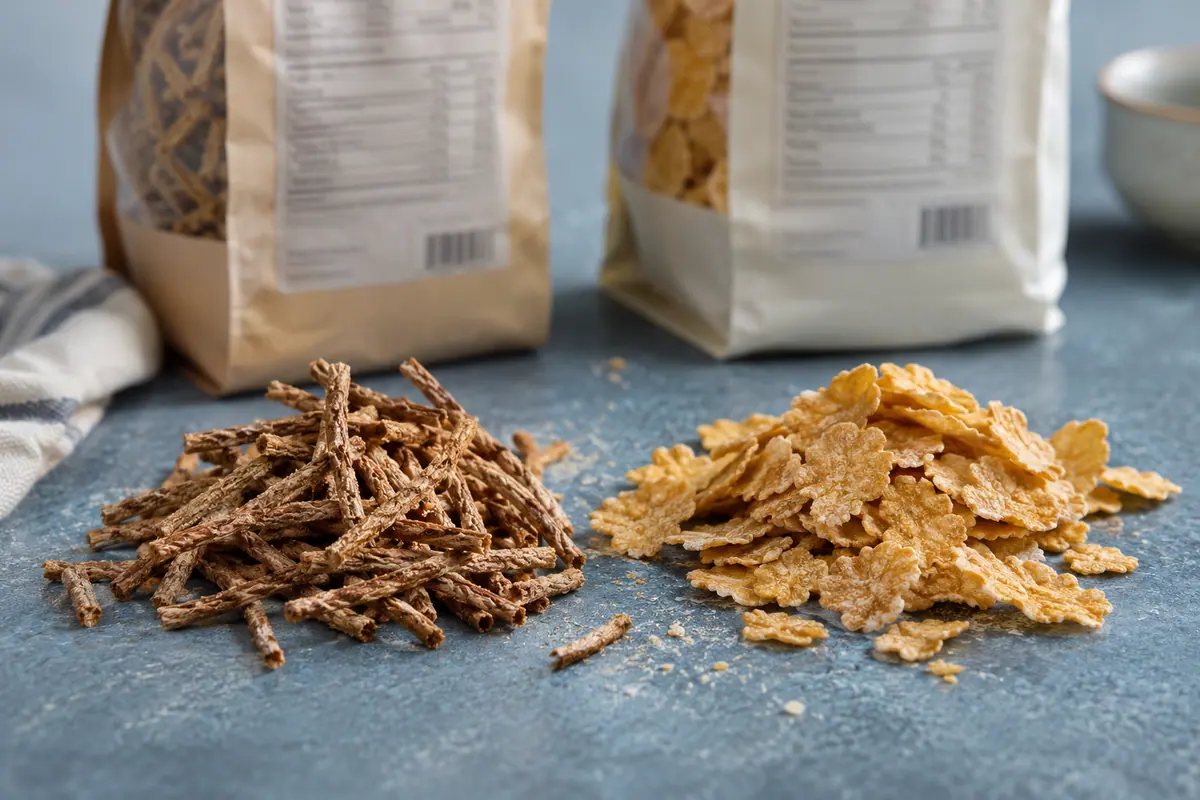
What the same cereal could look like on two labels
Suppose one portion of a cereal contains 18 g of available carbohydrate and 5 g of fibre, with no sugar alcohols. These are invented values to show the arithmetic. Both example panels describe exactly the same portion.
A US-style panel would show 23 g total carbohydrate and 5 g dietary fiber. Subtracting the 5 once gives 18 g. On the UK panel the carbohydrate figure is already 18 g, with fibre shown separately. Subtracting 5 from 18 would produce a misleading 13 g.
| Nutrition panel | Carbohydrate shown | Fibre shown |
|---|---|---|
| US or Canada, illustrative serving | 23 g, includes fibre | 5 g |
| UK, same illustrative serving | 18 g, excludes fibre | 5 g |
Follow the carbohydrate row across the panel
On a US Nutrition Facts panel, begin with Total Carbohydrate and read the indented lines beneath it. In Canada you may see simply Carbohydrate. Health Canada explains that the figure includes fibre, starch and sugars. The sugars line tells you one part of that total. Adding it again counts that part twice.
UK packages commonly give values per 100 g, while a North American panel often leads with one serving. For a fair comparison, make both amounts refer to the same weight first. A 30 g serving with 21 g carbohydrate corresponds to 70 g per 100 g. This difference in scale is separate from the treatment of fibre.
Find the calculation behind a net-carb claim
A maker may subtract fibre, certain sugar alcohols or both to arrive at its front-of-pack number. Sugar alcohols are also called polyols. If a pack gives its calculation, read which ingredients it includes and the portion it uses. A simple fibre subtraction may give a different result.
For an everyday diary, copy the labelled carbohydrate value with its serving and market. If you choose to track a separate calculated figure, keep the original total and calculation identifiable. For a medically prescribed counting method, use the approach agreed with your care team.
Choose the record for the pack in your hand
Look for the brand, flavour and portion. An imported pack can have a local nutrition sticker, and an online database can contain entries from several countries. If two records disagree, look at the row names and fibre as well as the food name. When the figures on your pack are clear, manual entry lets you use those figures directly.