Food labels
How to read % Daily Value on a Canadian food label
By Uptick3 min read
On a Canadian Nutrition Facts table, the % Daily Value (% DV) tells you how much one stated serving contributes towards a reference amount for a nutrient. Health Canada’s quick guide treats 5% or less as a little and 15% or more as a lot. Start with the serving size printed at the top.
A soup can have one % DV for fibre and another for sodium. Read the row for the nutrient you want to compare. There is no single % DV score for the food, and those percentages do not give the fraction of calories from a nutrient.
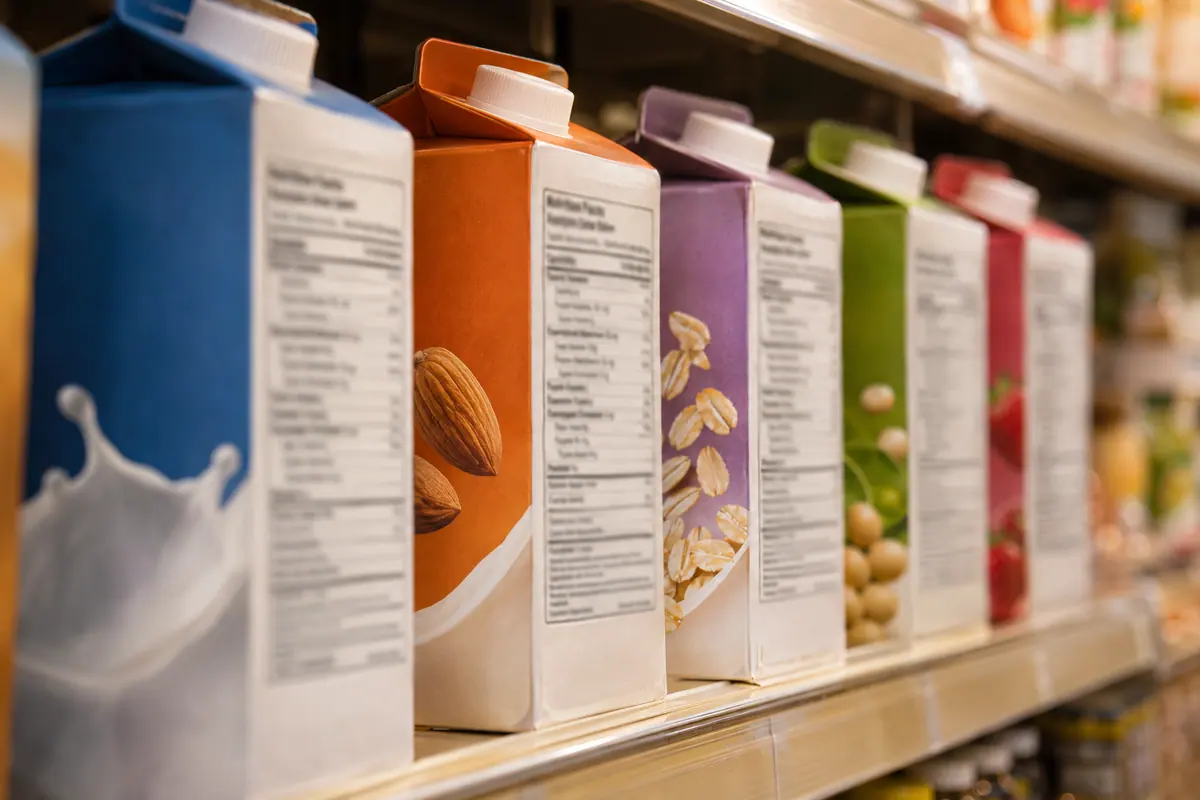
Put two cartons on the same serving size
Imagine one soup lists 10% DV sodium per 125 mL and a second lists 14% per 250 mL. Comparing 10 with 14 makes the first carton look lower. For an equal 250 mL bowl, the first gives about 20% and the second gives 14%. The serving size changes which one has less sodium for your bowl.
Use the weight or volume line underneath “Nutrition Facts” or “Valeur nutritive”. If two crackers have different sizes, the same number of crackers can represent different weights. Compare equal weights or the portion you actually intend to eat.
| Example carton | Printed serving | Approximate sodium % DV for 250 mL |
|---|---|---|
| Soup A | 10% per 125 mL | 20% |
| Soup B | 14% per 250 mL | 14% |
Read “a little” and “a lot” nutrient by nutrient
A 4% figure falls in the “a little” range. A 17% figure falls in the “a lot” range. A value between 5% and 15% lies between those markers. Health Canada applies the guide to nutrients with a % DV in the table.
You can use the same method in either direction. Someone comparing fibre can look for the larger figure at the same serving size. Someone comparing sodium can look for the smaller one. This leaves room for differences in price, taste and the rest of the meal.
Put the amount and its unit into your diary
A gram is a quantity. A percentage describes a share of a reference. If a fictional label lists 4 g of fat and 5% DV, enter 4 g in a fat field. Entering 5 g because you saw a 5% figure changes the record. If your portion was half the printed serving, the fat contribution is about 2 g.
Keep milligrams with milligrams too. A sodium figure such as 250 mg is 0.25 g. When a barcode result is available, compare its serving size and units with the pack before trusting the match.
Use the reference for the market on the pack
Different countries use their own labelling conventions. Read the Canadian explanation for a Canadian pack. If you double the serving, doubling the printed % DV gives a practical approximation because the original percentage may already have been rounded. The reference on a general label also cannot tell you the intake that is right for an individual.