Portion sizes
Convert millilitres to grams for milk, oil, water and rice
By Uptick3 min read
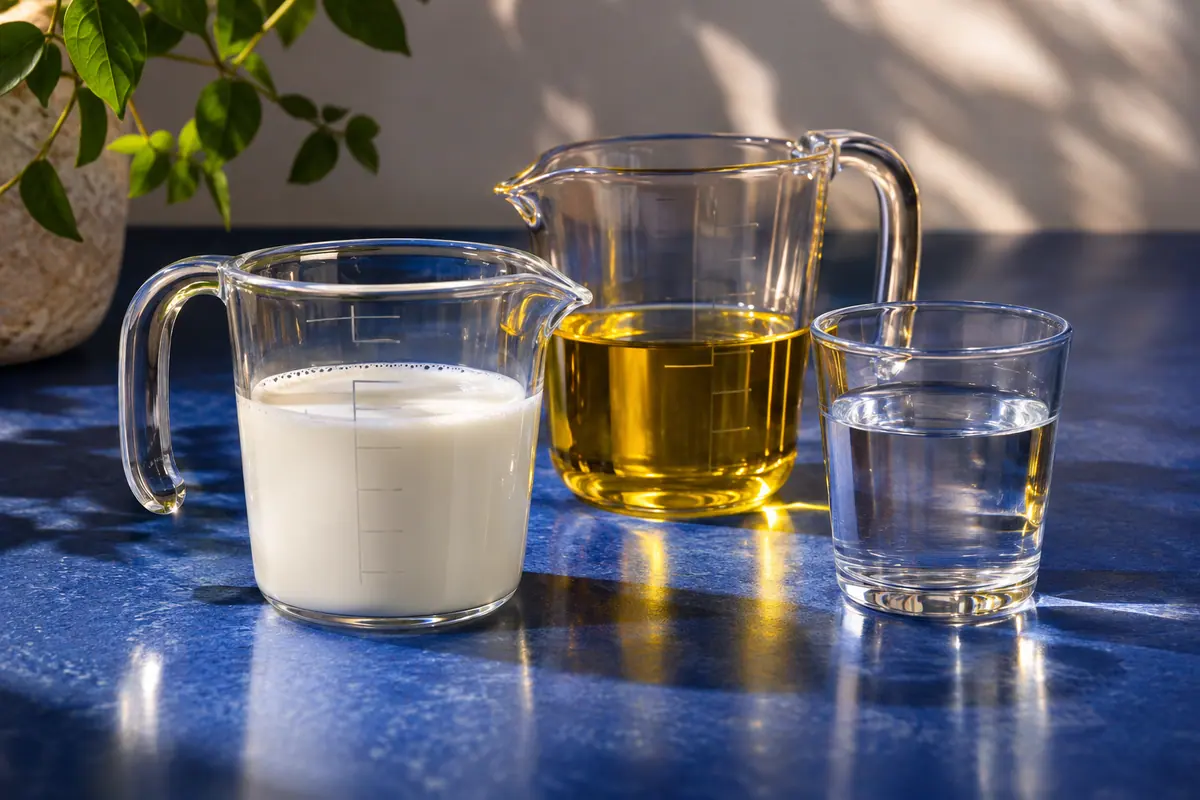
Multiply the volume in millilitres by the ingredient’s density in grams per millilitre. For a kitchen estimate, 100 mL of water weighs about 100 g. The same volume of liquid cow’s milk weighs about 103 g and olive oil about 92 g. Choose the ingredient before converting.
You only need this calculation when the units differ. A drink with nutrition per 100 mL can be logged directly from a volume measured in mL. A recipe or food record with nutrition per 100 g needs a weight.
Convert a measured volume to grams
What each ingredient setting uses
The presets come from the FAO/INFOODS Density Database. They are kitchen estimates. Temperature, brand and preparation matter, and grains can settle differently in a measuring jug. The oil setting uses the midpoint of the published olive oil range of 0.91–0.92 g/mL at 15.6 °C.
| Ingredient | Density used | Approximate mass of 100 mL |
|---|---|---|
| Water | 1 g/mL | 100 g |
| Liquid cow’s milk | 1.03 g/mL | 103 g |
| Olive oil | 0.915 g/mL | 91.5 g |
| Boiled white rice | 0.73 g/mL | 73 g |
Try a small measure of oil and a glass of milk
For 15 mL of olive oil, multiply 15 by 0.915. That gives about 13.7 g. For 250 mL of milk, multiply 250 by 1.03 to get about 257.5 g. If the nutrition record asks for grams, enter the converted weight. If it asks for mL, use the volume you started with.
Check it the other way if you have a scale reading. Divide the grams by the same density to get the volume. For example, 206 g of this milk estimate divided by 1.03 gives 200 mL. A 206 g portion of a different ingredient would give another result.
Measure a density for your own ingredient
For an unlisted ingredient, use a scale and a measuring jug. A kitchen scale measures the portion directly, which is often the simplest choice. Measuring a density is useful when you repeatedly scoop the same food by volume.
- Place the empty jug on the scale and tare it to zero.
- Add a known volume of the ingredient and record its weight in grams. Use the same filling method you normally use.
- Divide the weight by the measured mL. If 200 mL of your ingredient weighs 160 g, its measured density is 0.8 g/mL.
- Choose “Custom density” in the converter and enter that value. For 75 mL of this example ingredient, the result is 60 g.
Match the form of the food before using the result
The rice setting is for boiled white rice. Dry rice has a different bulk density and gains water in cooking. Use the weight with a nutrition record that also describes cooked rice. For a different type, a tightly packed scoop, or a mixed dish with sauce, weigh the portion if you can.
For a batch you cook regularly, record the weight of the finished batch once and divide according to what you serve. That can be more repeatable than converting a different scoop every day.